

TBF News:
Fall 2025
Across every community and area of need, nonprofit leaders see their work being made more difficult while demand for their services rises. Such findings inform our actions to meet this moment, some of which we cover in this edition of TBF News.
Rapid Assessment: Sounding the Alarm
The Boston Foundation, Massachusetts Nonprofit Network, and the MassINC Polling Group
Rapid Response: Safety Net Grants
A Community Effort
Supporting Safety Net Grants
David and Jill Adler
Rapid Results: SNG at Work
SNG grantee PAIR Project - with Detention Program Manager Irene Freidel
Charting Paths from Arriving to Thriving
Nickey Nesbeth, Executive Director of the Caribbean Youth Club and BRICC Safety Net Shelter
Research Roundup
Boston Indicators
Arts in an Uncertain Time
The Humanizing Force of Art
From Our President and CEO
M. Lee Pelton


Rapid Assessment: Sounding the Alarm
Listening to our nonprofit partners, TBF knew that anxiety was high as the year began and political change was clearly afoot. To clarify the sector’s concerns, the Boston Foundation partnered with Massachusetts Nonprofit Network and the MassINC Polling Group to devise and distribute a survey of nonprofit leaders. In the field in February and March, it asked respondents to weigh in on anticipated changes under the new administration, from the general—e.g., will your organization be better off, worse off, the same—to specifics about funding or client needs.
The analysis of more than 500 responses was released in May—at TBF’s largest convening to date, with 1,200 attendees in person or online— and showed nonprofits fearing shortfalls due to loss of direct federal funding, or to funding cuts elsewhere reducing indirect supports, or to donors spreading their giving to defunded organizations. Meanwhile, demand for nonprofit services was already ballooning with needs and threats increasing safety nets eroding.
The survey showed fear and stress generated by the purposeful chaos was widespread and confirmed hunches about subsectors at particular risk. High level findings and discussion points from the panel convened to discuss the study have been published online, and a follow-up survey is planned.
But data drives action at TBF. Senior Program Officer Leigh Handschuh says, “The results helped define the emerging scope and scale of the impact and where the need for technical assistance was greatest. For example, with donor support, TBF granted more than $100,000 to Lawyers for Civil Rights for pro bono legal clinics for nonprofits, to answer questions and share information on governance, compliance, and more.” Nearly 60 nonprofits have attended these ongoing sessions to date.
"Already, many in the immigrant communities we work with are afraid to leave their houses, regardless of their documentation status."
"As a food pantry, cuts to SNAP benefits, Medicare, and Medicaid threaten to drive even more need for our services."
"We think our work will increase as people are losing jobs and benefits."
"We have not been paid on all of our federal grants, including for work we have already completed."
Rapid Response: Safety Net Grants
The Safety Net Grant (SNG) program has been the Boston Foundation’s direct response fund for several years. Many of TBF’s discretionary grantmaking investments are long term and strategically parlayed for future outcomes. Yet we know the value of supporting local organizations doing important work right now. The spring 2025 round of grants was slated to disburse $2 million to 40–50 such orgs. Our current crisis of social institutions, however, called for a special round.
We asked donors to help us meet the moment. And they did. The fund pool quickly expanded by 31 percent as donors added $600,000. David Adler, one of these donors, recalls, “It started with a conversation with [Associate Vice President, Donor Services and Relations] Julie Smith-Bartoloni. She said, ‘We’re aiming to increase the pool here. Would you be interested in making a significant donation?’ We said yes. Like everybody, we were feeling at a loss about how to help and where to give.” His wife, Jill Adler, added, “And ‘safety net’ makes so much sense, because the safety nets are being taken away.” (Meet the Adlers below.)
In late April, the Safety Net Grants program issued a special round of more than $2.6 million in grants to 77 organizations. The full list is posted here.
More than 530 organizations applied for these grants, confirming the amplified need the nonprofit survey forecasted (in previous story). The difficult selection was advised by 57 community leaders in an inclusive process completed in just six weeks.
Reviewers, representing a cross-section of Massachusetts nonprofits and compensated for their time, were guided by funding considerations established for SNG and adapted for this round.
"There’s a lot that people who haven’t walked in my shoes may be unaware of, so I was pleased that TBF took the initiative to say, ‘You’re in this and see what’s happening,’ and was willing to trust the leadership of the community.”
—Reviewer Connie Forbes, Future Chefs Finance & Operations Associate
"I was inspired by the creativity, resilience, and deep commitment organizations bring to supporting their communities. It gave me a broader view of the ecosystem and reminded me that there’s incredible strength across our state.”
—Reviewer Tre’Andre Carmel Valentine, Mass Transgender Political Coalition Executive Director

The grants, $25,000 a year for one or two years, are unrestricted and can be used for general operating expenses— a nonglamorous but life-sustaining line item for any organization. At grantee PAIR Project, Director of Development Yanzie Chow says, “Given how much flexibility our programs need at this time to address the influx of challenges we’re facing, every unrestricted dollar we can get makes a tremendous impact for us.” (See more in the following story.)
In a July op-ed for Nonprofit Quarterly, SNG Senior Program Officer Candace Burton shared how TBF accelerated the pace and scope of this essential program while maintaining its community-powered and equity-focused approach. She stressed the importance of trust. “Our donor base responded. Our board supported new processes. We knew our community partners would use their knowledge and lived experience to choose a slate of remarkable grantees, and they did.”
Read more:
Supporting Safety Net Grants
David and Jill Adler joined TBF’s donor community in 2005, when an inheritance allowed them to set up a donor advised fund at the Foundation. Both are mental health professionals and have focused their giving in areas of mental health, families and children, single mothers, and poverty. They’ve notably sustained Breaktime, The Children’s Room, Horizons for Homeless Children, and the Nurtury, with smaller grants to more than 300 other organizations over the years. David Adler says, “The wonderful thing about the Boston Foundation is that it’s done very well with its investments. So, we’ve been able to give $800,000 over a 20-year period and still have money left to give, which is essential because we’re in an awful, crazy time just now.”
They prefer to support small and medium-sized organizations that are well run, and TBF’s relationships and knowledge of the communities and nonprofits serving Greater Boston helps inform their giving. That made supporting the special round of Safety Net Grants in this dire moment an easy choice.
They said, “We could not possibly do the research necessary. We obviously trust the Boston Foundation. It made sense to say, ‘You tell us what you’re doing, and we’ll support that.’”

Rapid Results: SNG at Work
Given the intensity of anti- immigrant activity at the federal level, and the importance of immigration to Massachusetts’ economic and cultural life, it makes sense that 69 percent of grantees report serving immigrants and refugees.
As we sat down to our scheduled Zoom call with Detention Program Manager Irene Freidel, her phone lit up with messages from a client, a young man being detained by ICE at that moment. Unable to reach him, or anyone on the ICE phone number he’d called from, she said, “They refuse to talk to me even though I’m his lawyer. They’re telling him they’re detaining him because of a violation but they won’t tell him what the violation is. I just checked his [asylum] case online. It’s still pending. Nothing’s changed, so they can’t deport him, but they’re going to detain him anyway. He said they’ve already put him in chains.” She added, “This is happening all over the country, every minute of every day...There’s not enough funding to get all the lawyers we need because the demand is so enormous.”
PAIR’s staff is fewer than 20, but since January 20, Freidel says, “Huge numbers of lawyers have volunteered to help. Most have never done an immigration case. We provide mentoring and training, sample documents, all the handholding that’s required, which is very time consuming. But it means we can take many more cases. It increases our capacity substantially.”
TBF continues responding to immediate need, and in September disbursed $1.9 million to regional food security efforts through our Meeting the Moment: Sustaining Families grants. Read more:
For first investment of this initiative, TBF commits a $1 million grant to the Greater Boston Food Bank.
TBF partners with donors to distribute $900,000 for second round of grants to 9 regional food nonprofits.

Safety Net Grants Program Grantees Main Missions
Housing & Shelter: 6.5%
Health Care: 6.5%
Community Improvement & Capacity Building: 7.8%
Youth Development: 7.8%
Food, Agriculture & Nutrition: 10.4%
Civil Rights, Social Action & Advocacy: 16.9%
Human Services: 44.1%
*69% serve immigrants
TBF helped Nesbeth build a coalition of 40+ organizations with connections to workforce development, immigrant settlement, and education to work through the issue together.
Two actionable needs emerged: recognition of professional certifications earned in other countries, and consistent programs to teach workplace-relevant ESOL. Conversations centered on achieving better coordination and funding across state systems supporting immigrants, especially in ESOL for employment, where current waitlists stretch to 25,000 people. “ESOL training leads to a 29 percent increase in weekly wages,” says SkillWorks Executive Director Andre Green. “As importantly, without these workers, our economy will shrink.”
The coalition, English for a Strong Economy, advocated for An Act to promote Economic Mobility through ESOL (S.1326), to invest $13 million in vocational ESOL and coordinate programs statewide.
In June, TBF hosted a forum to discuss these themes alongside a new report from the Gastón Institute at UMass Boston, supported by TBF’s Latino Equity Fund and SkillWorks. The title, Tienen alas pero no las pueden usar (They have wings but cannot use them) aptly describes the potential wasted when foreign-born and/or foreign-trained workers and professionals cannot apply their talents and experiences here in the Commonwealth.
After the event, many participants including TBF’s Public Affairs team went directly to the State House to testify in favor of the bill. It is currently referred to the Joint Committee on Labor and Workforce Development. The advocacy continues.


Nickey Nesbeth was a panelist at TBF’s June event. Besides leading the charge with the English for a Strong Economy coalition, she runs Caribbean Youth Club in Mattapan and an extensive resettlement program for new arrivals through Black Refugee and Immigrant Community Coalition (BRICC). Originally from Jamaica herself, she knows the new arrival experience—a simultaneous flood of loss and hope—and the many challenges it brings.
A scholar of history, Nesbeth sees American labor and immigration as inseparable. Thus resettlement and workforce development go hand in hand too. Housing comes first. Then employment, which often calls for ESOL, computer or other training. “If people have housing and work, then they’re stable. And now they’re contributing to the society,” says Nesbeth. “When someone comes here, they come with dreams and aspirations. If there isn’t a path toward actualizing those aspirations, they get lost. Then, as a society, we lose out.”
“If people have housing and work, then they’re stable. And now they’re contributing to the society. When someone comes here, they come with dreams and aspirations. If there isn’t a path toward actualizing those aspirations, they get lost. Then, as a society, we lose out.”


Research Roundup
We are lucky to serve a community where research is expertly conducted and broadly appreciated. Research is both a fuel and a navigation tool on our pathways to equity: Findings can inspire action and guide the direction that action takes. TBF is constantly adding to our library of civic knowledge. Here are reports released since May 1, 2025, click on the covers to learn more and read them.


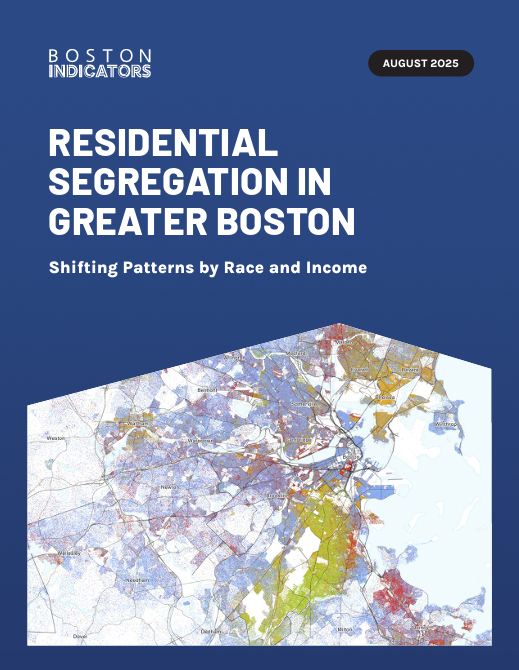
Arts in an Uncertain Time
TBF did not shy away from the humanizing force of art during this turbulent spring and summer.
Our Community Wealth: Arts & Creativity and Events teams produced a triad of gatherings focused on arts and culture in the Commonwealth and themed The Future of . . .
- Creative Workforce Development and Entrepreneurship: A panel discussed challenges, opportunities, and tactics in achieving a more collaborative and integrative creative economy and arts sector.
- Creative and Live-Work Spaces: Attendees explored ways to develop, protect, and stabilize artist live-work spaces. (Artists for Humanity, MassCreative, and Zumix co-hosted.)
- Collective Action for the Arts & Culture Sector: Leaders and activists tackled the question: How can we organize to defend, mobilize, and expand the role of the arts in society?
The Asian Community Fund at TBF produced a groundbreaking assessment of the state of the Asian American and Pacific Islander arts and culture sector in Massachusetts. With a packed house in the Edgerley Center, the ACF’s AAPI Arts & Culture Collaborative discussed the new report and celebrated the arts in real time with performances, poetry, and song.
Our reports and convenings may identify challenges, but our grants programs find an abundance of talent and promise in the local arts scene. In September the biannual Brother Thomas Fellowship announced 17 new Fellows. Chosen by a two-step nomination and community-panel process, these creatives work at high levels of excellence and ambition and express the diversity of human experience.

From Our President and CEO M. Lee Pelton
Earlier this year TBF facilitated a survey of nonprofit leaders, and the results show an acute sense of anxiety within the sector. Across every community and area of need, nonprofit
leaders see their work being made more difficult while demand for their services rises. Such findings inform our actions to meet this moment.
At TBF we believe in data. It is neither infallible nor immutable, but with good-faith critical analysis and openness to updates, it is our best foundation for positive change. Data doesn’t solve problems, especially the complex and systemic ones that face us in housing, education, or health care. It does, however, provide us with insights into what is working and what is not. We use it to guide and assess strategies to tackle problems meaningfully.
As we face a daily onslaught of new alarms and challenges, TBF, with our partners, will use every tool we have—starting with research, listening, and learning and extending to convening, advocacy, and funding—to respond. Thank you for walking this path with us.
"At TBF we believe in data...it is our best foundation for positive change."

PARTNER WITH US...to move equity forward.
Give to our Annual Fund for Civic Leadership at tbf.org/civicleadership.