
Recap: ADUs Turn One: Regulatory Barriers to production in Massachusetts and Ideas for Further Reform
May 20, 2026
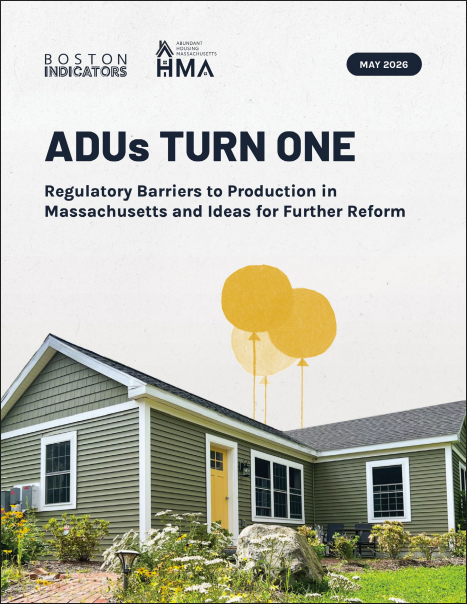
On May 20, Boston Indicators and Abundant Housing Massachusetts (AHMA) jointly released ADUs Turn One: Regulatory Barriers to Production in Massachusetts and Ideas for Further Reform, examining the first year of statewide accessory dwelling unit permitting under the Affordable Homes Act. The online event featured a report presentation followed by a panel discussion with voices from state government, local government, and advocates for expanding ADU availability.
Luc Schuster, Executive Director of Boston Indicators, opened by framing ADUs as a symbol of where Massachusetts housing policy stands today — there is encouraging momentum, but the end result lags behind what the state could achieve. He noted that the report is the first in a three-part Boston Indicators series on barriers to housing production, with follow-up reports on building codes and local permitting complexity coming in summer and fall 2026.
Lead researcher Amy Dain, a Senior Fellow at Boston Indicators, then presented the findings. In the 12 months following the law's February 2025 implementation, cities and towns received more than 1,600 ADU permit applications and granted over 1,200 permits across 217 municipalities — at least a tripling of the state's prior annual rate. Dain, who has been surveying ADU zoning in Massachusetts since 2004, put it simply: statewide legalization accomplished more in a single year than 50 years of local advocacy combined.
But the success comes with caution, she notes. Zoning legalization is only one layer of a much thicker regulatory stack. Local septic rules, wetlands regulations, stormwater requirements, and inconsistent fire and building code interpretations, all of which can vary widely by community, continue to add cost and uncertainty to every project. Her recommendations from the report included standardizing dimensional requirements statewide, strengthening state baselines for septic and wetlands rules to perhaps reduce state and local variability, and developing cross-agency guidebooks for property owners, builders, and municipal officials.
Jesse Kanson-Benanav, Executive Director of AHMA, echoed that message in his remarks as he introduced the panel — praising the law as among the strongest ADU statutes east of the Mississippi, while stressing that fragmented local permitting remains a meaningful barrier to its full impact.
Panelist Chris Lee of Backyard ADUs described what that fragmentation looks like on the ground: at least $20,000 per project in added pre-construction costs, and a business model that "just barely works" across 351 different permitting cultures. A recent Lexington project required over $75,000 in stormwater and wetlands engineering for two standard suburban ADUs. "We just need consistent rules that are enforced consistently statewide," he said.
Claire Morehouse, ADU Coordinator at the Executive Office of Housing and Livable Communities, outlined the state's response: a new ADU resource center for property owners, a model zoning document for municipalities, 92 free downloadable building plans from a statewide design challenge at mass.gov/ADUdesigns, and MassHousing construction loans of up to $250,000 for detached ADUs. She also noted that nearly a third of municipalities voluntarily amended their ADU bylaws in the law's first year — an unprecedented pace, though the Attorney General's office found inconsistencies in a significant share of those newly adopted bylaws.
Meredith Boericke of the Massachusetts Housing Partnership and the Braintree Town Council closed the panel by previewing MHP's forthcoming $10 million ADU Incentive Program, which will fund property-specific feasibility studies while gathering statewide data to shape future policy reform. Audience questions touched on fire safety codes, alternative septic solutions, and whether ADUs will ultimately be accessible to lower-income renters — a question panelists agreed will require deliberate policy attention over time.
The event closed on a note of cautious optimism. The first year of legalization is a real success, but 1,200 new permits against a shortage demanding hundreds of thousands of homes is a beginning, not a solution. The next phase of reform, all agreed, requires cleaning up the regulatory complexity that statewide ADU zoning reform alone could not touch.
The full report is available at bostonindicators.org. Free ADU design plans and homeowner resources are at mass.gov/ADUdesigns.

Agenda
Welcome and Opening Remarks
Luc Schuster, Executive Director, Boston Indicators Opening Remarks
Research Presentation
Amy Dain, Senior Fellow, Boston Indicators
Discussion and Audience Q&A
Meredith Boericke, ADU Program Director, Massachusetts Housing Partnership
Amy Dain, Senior Fellow, Boston Indicators
Chris Lee, CEO & Founder, Backyard ADUs
Claire Morehouse, ADU Coordinator, Massachusetts Executive Office of Housing and Livable Communities
Moderator: Jesse Kanson-Benanav, Executive Director, Abundant Housing Massachusetts