With the support of Social Finance, the Commonwealth was able to quickly design and establish the Fund, launching its first cohort of learners in the summer of 2025. Since then, the program has continued to make great strides and the Boston Foundation is proud to partner with Social Finance and the Commonwealth to support this innovative effort.
With less than $1 million in philanthropic capital remaining to be raised to unlock the final $2.7 million in public and private matching dollars, our Chief Program Officer and Vice President, Orlando Watkins, sat down with Tracy Palandjian to discuss the Fund’s work and impact.
Orlando Watkins: What are three words you’d use to describe the Massachusetts Climate Careers Fund? And why?
Tracy Palandjian: Impactful. Agency. And scalability. Let me dig into each of these.
Impactful. First, I see this Fund being impactful in three ways: one, placing learners into good paying jobs; next, stretching philanthropic dollars through a state match; and finally, the information value on ensuring we are allocating dollars to programs delivering the best results.
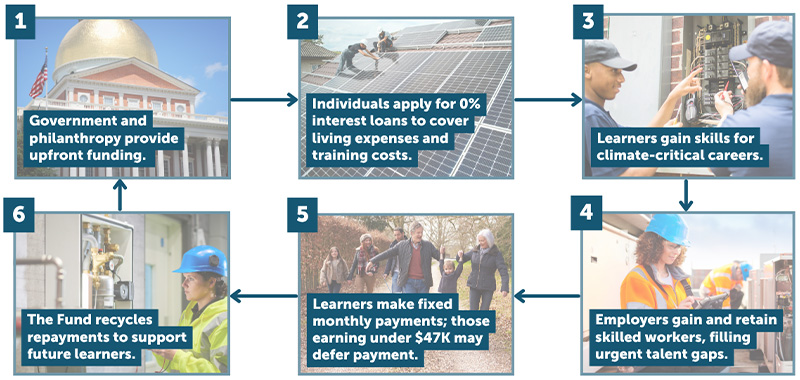
Second, agency. Community college is free in Massachusetts so people are using this money to meet living expenses like childcare, transportation, rent—and can decide how these funds are used to support their individual learning journey.
Finally, scalability. We are proud that the Commonwealth is the first state in the nation to lead in using this pay it forward structure focused on climate careers. So, the hope is that other states can replicate and scale this model across the country.
Orlando: When I think about these innovative finance models, I think about Social Finance’s role and leadership, growing and building this field. I know that these models come with a lot of rigor built into them in selecting program partners. How is that present in this Fund?
Tracy: The institutions being supported by this program include Greenfield Community College, Upper Cape Tech, Holyoke Community College, and Franklin Cummings Tech. We reviewed a wide range of training programs throughout the Commonwealth through a serious vetting process that included quantitative elements—like graduation and job placement rates—but also qualitative analysis, seeing the ways institutions learn and adapt to serve a broad range of learners’ needs to ensure they are successful.
Orlando: Well, I think you know this as a Board member of the Boston Foundation, but we’re big supporters of Franklin Cummings Tech (FCT), and have made a $1 million impact investment in their big capital project that is going to be a real catalytic force for the Nubian Square area. And they are an amazing institution, delivering real impact for their students, and we love to see our work supporting them through multiple partnerships and connected investments.
Tracy: It’s just like 1 + 1 equals 3 right? The synergies are powerful: TBF makes a capital impact investment in FCT, we are providing growth capital so that more students can benefit from the FCT program.
What makes this model unique is its pay-it-forward structure. Students receive a 0% interest loan to help cover program and living costs, and once they’re earning above a minimum income threshold, they repay the loan principal—either themselves or their employer. The repayments go back into the Fund and can support future learners, enabling the grant to have greater impact.
Orlando: This makes this a sort of sustainable grant dollar, and it can live several lives within the vehicle.
Tracy: Exactly.
Orlando: And can you remind me of the Commonwealth’s commitment?
Tracy: Governor Healey has committed $5 million of the Commonwealth’s budget to support this Fund, which is huge. However, to unlock that full amount we have to fundraise $5 million from philanthropy. We are less than $1 million away from fundraising the remaining amount and appreciate The Boston Foundation’s support of the Fund.
Orlando: We are proud to support this work, and it’s awesome to see what this public-private partnership is building and will unlock. Now that the program has been launched for 9 months, what are you hearing from learners?
Tracy: I’ll highlight two graduates from Greenfield Community College. One used the loan to help cover their housing and childcare expenses allowing them to persist and graduate and another used the loan to purchase a used car to get to their new job site. We were so moved by these student stories at the Greenfield Community College’s graduation ceremony, where they served a cake in the shape of a heat pump!
Orlando: I’m going to need to see a photo of that cake! But it’s terrific to hear the different ways this loan is helping support students. It really illustrates to me how this Fund is helping individuals build sustainable careers and earn wages to support their families. In addition, it’s supporting work that is contributing to a healthier, livable future for all of us.
Tracy: Precisely. These careers offer such significant economic opportunity for students. I think it’s important to note that when we say “climate careers,” what we are referring to are practical skill sets, largely in the trades, in skills such as plumbing, electrical and HVAC. The demand for workers in these fields is only growing.
Orlando: These careers are critical, for our climate as well as the changing workforce landscape. Regardless of AI and technology advances, these are going to be permanent jobs that we will always need. This further supports how important it is to invest in our communities that have these kinds of workforce opportunities.
Tracy: I completely agree, Orlando. You mentioned AI, these are AI-resilient jobs, these are well paying jobs. For example, HVAC technicians or Electricians have starting salaries above $47K, with median earnings reaching $77K.
Orlando: I wanted to close with one final question, and hopefully an easy one. What makes you most excited about this Fund and the role that philanthropy can play in catalyzing it?
Tracy: How often do we have a win-win-win opportunity that’s a leverage upon leverage? What I mean by this is the Massachusetts Climate Careers Fund is a win for individual human beings. It’s a win for climate. It’s a win for business and our economy. And the leverage here is rare: each philanthropic dollar that we can raise together will unlock a state dollar.
Orlando: Tracy, thank you so much for your leadership with this Fund. I’m proud to call you a partner and friend in this work, and as always, our conversations are leaving me energized, pun intended.