
ADUs are growing in popularity in Mass., report finds, but issues with cost, local codes blunt statewide permitting impact
May 20, 2026
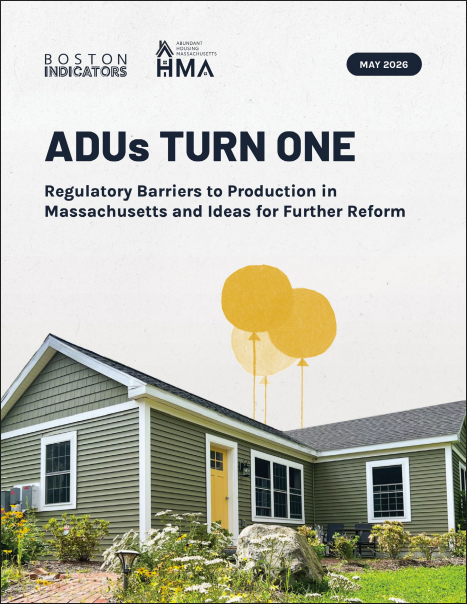
Boston – A new report from Boston Indicators, the research center at the Boston Foundation, and Abundant Housing Massachusetts finds that Massachusetts’ new statewide permitting pathway for accessory dwelling units, known as ADUs, has sparked notable growth in the number of ADU permit applications and built units. But the report, ADUs Turn One: Regulatory Barriers to Production in Massachusetts and Ideas for Further Reform, also notes that ADU production still lags the pace needed to reduce the state’s housing shortfall, with construction costs compounded by local regulations that delay or derail homeowners’ plans.
“The statewide approach to zoning reform has proven necessary to spark concrete results at a pace to make a real impact on housing supply,” said Amy Dain, Senior Fellow at Boston Indicators and lead author of the report. “But while statewide ADU permitting is making ADU construction more possible, our fragmented, complex system of local fire, septic, stormwater and other regulations creates challenges that discourage homeowners and make ADU construction less likely.”
The Commonwealth reformed the state Zoning Act as part of the 2024 Affordable Homes Act to legalize ADUs “by right” statewide, partially overriding local zoning prohibitions and other restrictions for ADUs of no more than 900 square feet of floor area or half the floor area of the principal dwelling, whichever is smaller. However, the Act does allow for “reasonable” local zoning regulations and for other local regulations.
The Act’s passage unquestionably sparked an increase in ADU applications and permitting. To measure the impact, the Executive Office of Housing and Livable Communities surveyed building officials in all 351 municipalities in Massachusetts. 293 responded, reporting receiving a total of 1,639 applications for ADU building permits and issuing 1,224 permits. Those numbers underestimate the real counts – as 58 communities did not respond and 65 others only provided numbers for the first half of the year. But they give some sense that the legalization did spark a wave of interest in ADUs across Massachusetts.

Boston, Plymouth, Lawrence, Nantucket, Lowell, Milton and Somerville led the list of communities granting the most permits in the survey, with at least 32 communities granting more than 10 ADU permits under state and local regulations in 2025.
Even with the progress, there are clear obstacles to ADU construction that have emerged which are slowly the process for applicants, particularly at the local level, where each of the state’s 351 municipalities has its own sets of building, fire, septic, wetlands, energy and stormwater codes that complicate the permitting process for both property owners applying to build ADUs and communities managing the approval process.
“If we are to truly unlock the potential of ADUs to create new and much-needed housing in Massachusetts, we must recognize that the Affordable Homes Act was just a first step,” said Jesse Kanson-Benanav, Executive Director of Abundant Housing Massachusetts. “Homeowners seeking ADU permits face a tangled web of local barriers related to zoning, building codes, fire codes, septic systems, stormwater, and wetlands that vary from community to community. Standardizing, regionalizing and coordinating regulations around ADUs are necessary next steps to build upon.”
The report makes a series of recommendations to sustain the gains underway. They include:
- Clear, uniform state regulatory standards for ADUs, with minimal opportunities for municipal-level variation
- A review of state regulatory standards for ADUs and revision to support ADU production while protecting health, safety, and the environment.
- Regionalization of permit review processes to reduce the burden on applicants and the staffing and technical expertise requirements for cities and towns.
- Improved cross-departmental coordination at the local and state levels to make the system easier to navigate for applicants.
The report also spells out a series of recommendations for state-level regulatory reforms to clarify ADU requirements, reduce unnecessary or redundant regulations and provide consistent and strong safety, health and environmental protections.
The report is available now at bostonindicators.org.