
New report finds Massachusetts uniquely vulnerable to economic impact of federal immigration crackdown
Value of immigrants in key industries and overall population growth put state at risk from funding cuts, destruction of immigration pathways
June 4, 2026
Boston – A new report from Boston Indicators, the research center at the Boston Foundation, and the MassINC Policy Center finds that Massachusetts faces significant demographic and economic impacts from continuing efforts by the Trump Administration to implement broad-based cuts to immigration into the United States.
Combining demographic and labor market analysis with interviews conducted with people working in life sciences, healthcare, and construction, An Uncertain Future: How the Immigration Crackdown Threatens Massachusetts’ Labor Force highlights the impacts of restricting immigration on a state with one of the lowest native birth rates in the country. The report does not evaluate the impact of specific restriction proposals but rather explores the contributions of immigrants to the Massachusetts economy and the sectors and places where restrictions to immigration will continue to have the largest impact.
“This report illustrates in stark terms how policies to shut down or restrict immigration pathways will have significant negative impact for our overall population and labor force in Massachusetts, with even more troubling results for industries like education and healthcare and for communities around the state for whom immigration is a source of continuing growth and economic opportunity,” said Lee Pelton, President and CEO of the Boston Foundation.

“The nature of the Massachusetts economy makes it more vulnerable to the disruption of our immigration system than many other parts of the country,” said Ben Forman, Director of the MassINC Policy Center. “A broad-based crackdown on immigration pathways has impacts on both high- and lower-skill industries, triggering disruptions that touch the lives of virtually every person in the Commonwealth, but are felt most strongly in our Gateway Cities.”
Immigration as a Stabilizing Presence in the Labor Force
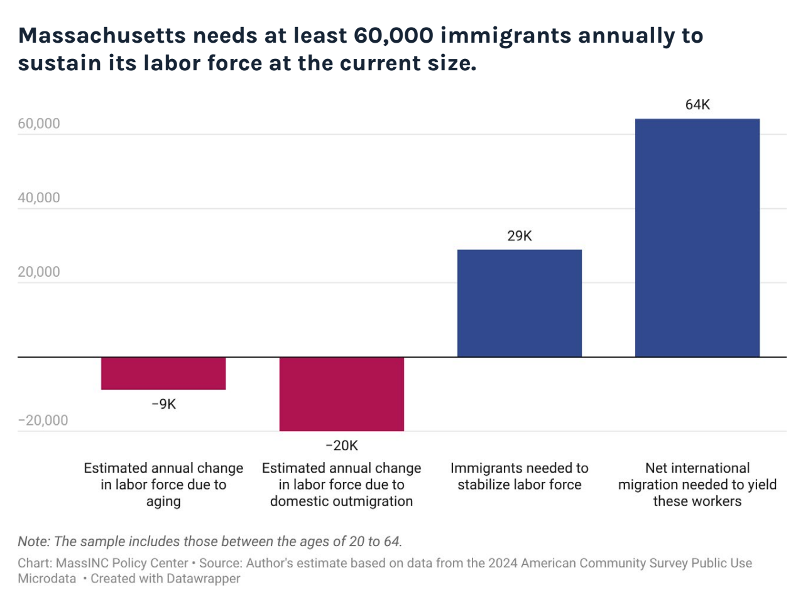
The collapse in international immigration forced by federal policy changes will make it more difficult for Massachusetts to sustain its labor force. Report authors from Boston Indicators and the MassINC Policy Center estimate that because of domestic outmigration and the aging of the Massachusetts labor force, the state would need an estimated 64,000 net international immigrants to maintain current labor force levels. The estimated net immigrant migration to the state in 2026 is estimated to be less than half of that (roughly 29,000 people).
“These immigrant workers don’t just fill jobs, they contribute markedly to the Massachusetts economy,” noted Kimberly Goulart, Senior Research Analyst at Boston Indicators. “Our estimates show foreign-born heads of households in Massachusetts had more than $50 billion in spending power in 2024. On top of that, these households contributed about $7.4 billion in state and local taxes and more than $23 billion in federal taxes.”
Immigrants at Work: Challenges to Massachusetts’ “Meds and Eds” Economy
Massachusetts’ immigrant labor force is unique in its educational spread – nearly one-third of immigrants in the state labor force have a master’s degree or more, compared to roughly one-fifth of native-born residents. And more than one-third of immigrant workers in Massachusetts have only a high school diploma or less. As a result, changing immigration rules has effects in research labs and innovation spaces as well as in construction, food service, healthcare and other service jobs.
The economic risk is notably acute in higher education, where universities, hospitals, biotech firms, and other research institutions depend heavily on global talent, and a pipeline of high-skilled undergraduate and graduate students.
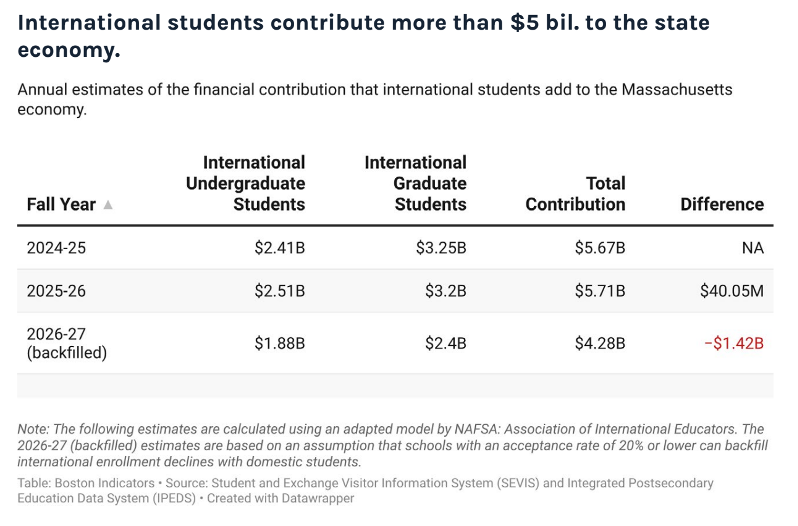
Adapting a model from NAFSA, a nonprofit association that promotes international education and exchange, a 30 percent drop in foreign student enrollment would have a negative impact of more than $1.4 billion dollars, even assuming that the most selective institutions would be able to backfill their international student losses with domestic students.
Restrictions and a new $100,000 fee for H1-B visas were also raised in interviews with industry leaders – the new fee forces companies to be more selective with sponsoring foreign workers, with the unintended result that companies move jobs offshore entirely if or when they cannot find similar talent locally.
At the other end of Massachusetts’ U-shaped pipeline, threats to broad-based immigration systems such as Temporary Protected Status (TPS) is exacerbating existing hiring challenges in direct care roles in places such as nursing homes, elder care and home health care. According to the Massachusetts Senior Care Association, nursing facilities in the state currently face vacancy rates in direct care roles of around 13 percent, even before accounting for potential immigration-related labor force losses.
Construction is another area facing challenges, as the industry tries to simultaneously ramp up production and maintain labor force levels. Industry representatives said that a reduction in the number of available workers, exacerbated by a fear of immigration enforcement, is leading to delays particularly among subcontractors that cost both time and money on projects.
Gateway Cities Under Stress: From Expansion to Rapid Contraction
The impact of rapid swings in immigration policy at the federal level are often most strongly felt in Massachusetts’ 26 Gateway Cities, where children with at least one immigrant parent now make up a growing share of the future labor force. The rapid increase in immigrant arrivals in many cities from 2022-2024 created one set of short-term challenges for city and school leaders in many cities, but researcher found no close correlation between increased numbers of foreign-born residents and housing prices in the Gateway Cities. Nor did researchers find a strong correlation between the growth in the foreign-born low-skilled labor force in Gateway Cities and earnings growth for lower-skilled workers over the past decade.

But, the researchers note, “A rapid contraction in our immigrant population could prove even more destabilizing than the latest increase in new arrivals.” Data has not yet captured real time population changes, but stories from Main Street business owners, declining school enrollments and higher absentee rates suggest reason for concern.
The full report is available now for download from Boston Indicators at bostonindicators.org.